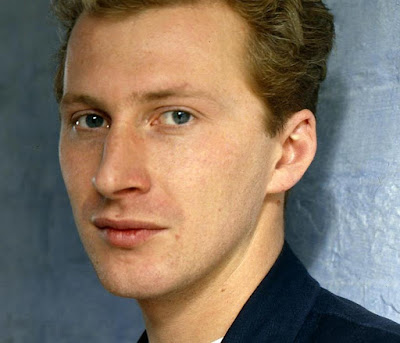
Half of this week's six debuts peaked exactly at the same position where they entered, so the only way is not always up! I didn't know any of this week's new entries at the time, so let's see what I think of them now...
Paul Rutherford: The way to 'get real' in the late 80s was apparently to frolic around in the desert.
Top 150 debuts:
Number 132 "Get Real" by Paul Rutherford
Peak: number 132
Peak date: 27 March 1989
Weeks in top 150: 1 week
Chart run: 157-(off chart for 1 week)-132
Weeks on chart: 2 weeks
Ex-Frankie Goes to Hollywood member Paul Rutherford launched his solo "career" with this track. I say "career" in inverted commas as it didn't really take off. This track peaked at number 47 in the UK back in October 1988, which is as good it got for solo Paul Rutherford on the chart. I am rather partial to the even less-successful follow-up (as is often the case for me) - a cover version of Chic's "I Want Your Love", which was released locally in May 1989, but did not chart at all here, sadly. Both tracks were produced by Mark White and Martin Fry, who were the sole remaining members of ABC by this point. Paul's more vocally-gifted former band mate Holly Johnson, of course performed much better with his solo debut, although his solo career was also short-lived. On the state charts, "Get Real" performed strongest in New South Wales/Australian Capital Territory, where it reached number 104.
Number 136 "Wholly Humble Heart" by Martin Stephenson & The Daintees
Peak: number 136
Peak date: 27 March 1989
Weeks in top 150: 6 weeks
Top 150 chart run: 136-142-143-141-146-142
Like Paul Rutherford, this single flopped in the UK in 1988 - peaking at number 81 in August 1988. Ah, the days when it took six months for something to finally get released in Australia... The album did better in the UK, though, peaking at number 39. While not exactly immediate, this song has a rather pleasant vibe, I think.
Serving this week's most 80s hair-dos, Vixen's biggest hit (number 22) in their native America had to settle for a peak outside the top 100 in Australia; although it peaked at number 76 on the rival Australian Music Report chart (what's 45 positions' difference here or there, eh?). On the state charts, "Cryin'" performed strongest in Victoria/Tasmania, where it reached number 59. The single peaked within the top 100 on all of the state charts except New South Wales/Australian Capital Territory. Vixen will join us again in August.
Number 145 "Honey Be Good" by The Bible
Peak: number 144
Peak date: 8 May 1989
Weeks in top 150: 4 weeks
Top 150 chart run: 145-(out for 5 weeks)-144-146-(out for 2 weeks)-147
Another one that performed much better on the Australian Music Report singles chart is this one, which peaked at number 87 on it, while number 144 is all it could muster on the ARIA chart. Despite that, it did spend four non-consecutive weeks hovering between numbers 144 and 147, with one week apiece spent at 144, 145, 146 and 147! Oddly, this one did not enter the band's native UK chart until August 1989, where it peaked at number 54. Quite a nice, if not spectacular, song.
Number 149 "Blueprint" by Rainbirds
Peak: number 149
Peak dates: 27 March 1989, 17 April 1989 and 1 May 1989
Weeks in top 150: 3 weeks
Top 150 chart run: 149-(out for 2 weeks)-149-(out for 1 week)-149
Weeks on chart: 8 weeks
Now here's a spectacular song - or so I think. I discovered this one last year, via a 'song contest' (where you submit a song that didn't chart so well, if at all, by an obscure-ish artist) on a pop forum. Rainbirds are a German band, and this single peaked at number 7 in their homeland in February 1988. It also performed much better on the Australian Music Report chart, where it peaked at number 96. On the ARIA chart, the single interestingly spent three non-consecutive weeks at number 149!
On the ARIA state charts, "Blueprint" performed strongest in South Australia/Northern Territory, where it reached number 70.
Although "Blueprint" would be Rainbirds' only single to chart in Australia, they had one (their only) charting album later in the year. Their second album Call Me Easy Say I'm Strong Love Me My Way It Ain't Wrong (now that's a mouthful!) peaked at number 138 on the ARIA albums chart in October 1989, despite no singles from it charting in Australia.
Number 150 "The Big Picture" by The Pony
Peak: number 125
Peak date: 1 May 1989
Weeks in top 150: 6 weeks
Top 150 chart run: 150-143-148-130-139-125
The Pony were a short-lived Australian band, going by their brief bio on discogs.com. This song is pleasant with a catchy chorus, though is not what I'd normally listen to. It sounds like it might have done better if released in about 1993.
Next week (3 April): Seven new entries, including... some Christian metal and a duet with a (then) recently-deceased singer. Don't forget, you can also follow my posts on facebook.
There are a mere three debuts peaking within the 101-150 section of the chart this week, with no real common thread between them, other than (once we include the bubbling WAY down under entry) we have both a fading teen star and a new one on the rise.
Tiffany: Tiff was rocking the double denim, if not the Australian charts, in 1989.
Top 150 debuts:
Number 125 "All This Time" by Tiffany
Peak: number 120
Peak date: 3 April 1989
Weeks in top 150: 7 weeks
Top 150 chart run: 125-122-120-124-128-124-128
Weeks on chart: 10 weeks
Tiffany's Australian chart career started on a high, with three consecutive top 15 hits. But single number four bombed, and the lead single from Tiff's second album Hold an Old Friend's Hand (number 56, January 1989), "Radio Romance" (number 65, January 1989), stalled at number 65. Tiffany's Oz chart trajectory continued its steep decline with this, the second single (though first in the US) from the album, "All This Time". Is it just me, or does Tiff sound like she has a cold on this track? I also thought the same thing about her vocals on "Radio Romance".
Internationally, "All This Time" peaked at number 6 on the US Billboard Hot 100 in February 1989, number 4 in Canada, number 47 in the UK in February 1989, and number 24 in Ireland in February 1989.
Locally, "All This Time" was most popular in South Australia/Northern Territory, where it reached number 79 on the state chart.
If you thought this would be Tiffany's last foray into the Australian charts, you would surprisingly be wrong. She has a bubbling WAY down under 'hit' coming up later in the year, and will be seen again in 1990 and 1993! Who knew?!
Number 145 "Yeah, Yeah, Yeah, Yeah, Yeah" by The Pogues
Peak: number 111
Peak date: 3 April 1989
Weeks in top 150: 6 weeks
Top 150 chart run: 145-138-111-137-131-128
This single was the Pogues' first appearance on the Australian singles chart, although an earlier-released single dueting with Kirsty MacColl would more-recently nudge the top 50. I assume the "I love your breasts, I love your thighs" lyrics are not referencing KFC... The Pogues join us again in 1990.
Number 146 "Hiwire Girl" by Catfish
Peak: number 146
Peak date: 20 March 1989
Weeks in top 150: 1 week
Top 150 chart run: 146
Before the term 'catfish' meant someone trying to trick you into an online relationship by using somebody else's pics, it was the name of an Australian band, who scored a number 72 'hit' in Australia in late 1988 with "The Early Hours". This follow-up didn't do quite as well. While it's not the sort of thing I'd normally listen to, I think this track is pretty decent. Catfish will join us again in 1991.
Bubbling WAY down under:
Number 168 "Drown in My Own Tears" by The Smithereens
Peak: number 168
Peak date: 20 March 1989
Weeks on chart: 1 week
American rock band The Smithereens formed in 1980. They did not release any material until 1986, however, scoring their first chart 'hit' in Australia when their debut single, "Blood and Roses", spent one week at number 99 in January 1987. Their debut album, Especially for You, similarly spent one week in the Australian top 100 albums chart, at number 87, in May 1987.
"Drown in My Own Tears" was issued as the second single from The Smithereens' second album Green Thoughts (number 85, June 1988), following "Only a Memory" (released locally in April 1988, did not chart).
"Drown in My Own Tears" does not appear to have registered on any other national chart, other than the pointless US Billboard Mainstream Rock Airplay chart, where it reached number 34 in October 1988.
Some readers may have known that before "Toy Soldiers" became an international smash hit for Martika, she had some more-subdued success with her debut single, "More Than You Know", which peaked at number 18 in the US in April 1989. While the single would go on to peak at number 32 in Australia when re-issued in January 1990, upon its initial release, "More Than You Know" debuted at number 160 this week on the Australian singles chart.
Next week (27 March): we have six new entries, including an ex-member of Frankie Goes to Hollywood - though it's not who you might think.
A big twelve new entries this week, from a varied bunch of artists. Let's take a look at them:
2 Brave: Looking sultry and wearing silly hats didn't seem to help this Scandinavian duo score a hit down under.
Top 150 debuts:
Number 117 "Windows of the World" by Pretenders
Peak: number 117
Peak dates: 13 March 1989 and 20 March 1989
Weeks in top 150: 5 weeks
Chart run: 174-(off chart for 1 week)-117-117-124-126-120
Weeks on chart: 6 weeks
Somewhat surprisingly, the Australian top 100 singles charts were a hit-free zone for Pretenders for almost 7 years, book-ended by two top ten hits - those being 1987's "Hymn to Her" (number 7, June 1987), and 1994's "I'll Stand by You" (number 8, June 1994). They did managed to 'bubble under' with this track, though, which is a cover of the Dionne Warwick song. Pretenders' version of "Windows of the World" was recorded for the 1969 soundtrack (number 134, July 1989).
Internationally, "Windows of the World" peaked at number 120 (number 102 on the compressed chart) in the UK in April 1989.
Domestically, "Windows of the World" performed strongest in New South Wales/Australian Capital Territory, where it reached number 89 on the state chart.
This single was Billy's first foray into the Australian singles chart... kind of. He'd reach the top 100 in 1991 with "Sexuality" (number 46, September 1991), and dented the ARIA top 50 albums chart with this song's parent album Workers Playtime (number 49, March 1989).
Internationally, "She's Got a New Spell" peaked at number 132 (number 112 on the compressed chart) in the UK in November 1988.
Locally, "She's Got a New Spell" was most popular in Queensland, where it reached number 96.
This track is lifted from the Buster soundtrack (number 35, March 1989), and was written by Phil Collins and Lamont Dozier. I remember seeing the video for this one on rage while waiting for the top 50 chart countdown to begin, early on a Saturday morning. This was the group's first Australian singles chart entry since "When She Was My Girl" peaked at number 54 in early 1982.
Elsewhere, "Loco in Acapulco" peaked at number 7 in the UK in January 1989, number 23 in Germany in January 1989, number 9 in Ireland, number 9 in the Netherlands in February 1989, and number 13 in the Flanders region of Belgium in February 1989.
Locally, "Loco in Acapulco" was most popular in Western Australia, where it peaked at number 86 on the state chart.
Number 143 "When I'm With You" by Sheriff
Peak: number 117
Peak date: 10 April 1989
Weeks in top 150: 6 weeks
Known chart run: 158-143-124-133-124-117-120
Weeks on chart: 8 weeks
The first and only Australian singles chart entry for this Canadian rock band has a rather interesting back-story. The song was originally released as a single in 1983 - although I can find no evidence of it being released locally then. The band split in 1985, and after a radio station in the US began playing the song in late 1988, it was re-issued there (after having peaked at number 61 in 1983). It then went on to top the US Billboard Hot 100 chart in February 1989, despite having no music video.
Another claim made about this song is that the note held at the end of it is the longest (19.3 second) note held by a male pop singer on record. Phew! As if all of that wasn't enough, two of the band's members went on to form part of Alias, who would score a hit in 1991 with "More Than Words Can Say" (number 30, April 1991).
On the state charts, "When I'm with You" performed strongest in Queensland, where it reached number 90.
Number 146 "Follow Your Heart" by The Party Boys
Peak: number 107
Peak date: 10 April 1989
Weeks in top 150: 11 weeks
Top 150 chart run: 146-(out for 1 week)-110-109-107-114-118-(out for 3 weeks)-123-131-130-132-134
Australia's Party Boys scored a big number one hit in 1987 with their version of "He's Gonna Step on You Again" (number 1, July 1987), but would have to settle for bubbling under the top 100 with this release, less than two years later. While it's not the sort of thing I normally listen to, I concede that the chorus is catchy. Despite peaking at number 107, this single spent 11 weeks in the 101-150 section of the chart.
A certain Scandinavian duo hailing from Sweden would conquer the Australian charts in 1989, but this duo, originating in Norway, couldn't manage to crack the top 140. It's a shame, really, as this is quite a good slice of infectious pop music that I hadn't heard before. I wonder who knew about it locally to snap up sufficient copies of it to dent the top 150? The duo had greater success in their homeland, where this reached number 4.
Number 148 "Johnny" by The Celibate Rifles
Peak: number 128
Peak date: 10 April 1989
Weeks in top 150: 7 weeks
Chart run: 148-134-131-137-128-136-137
Weeks on chart: 7 weeks
Despite forming in 1979, this was actually the Australian band's first taste of chart 'success'; albeit, at a rather modest level. "Johnny" is lifted from The Celibate Rifles' fifth studio album Blind Ear (number 85, July 1989). They'll go on to visit the 101-150 section of the singles chart on no fewer than four other occasions in the coming three years.
On the state charts, "Johnny" performed strongest in South Australia/Northern Territory, where it reached number 86.
The Celibate Rifles will next join us in June 1989.
Number 149 "Why Does Love Got to Be So Sad" by Buckwheat Zydeco
Peak: number 129
Peak date: 10 April 1989
Weeks in top 150: 7 weeks
Top 150 chart run: 149-147-141-140-129-138-(out for 1 week)-141
This is another one I'd never heard of before. Buckwheat, born Stanley Dural, Jr., was an American accordionist. I say 'was', because he sadly passed in 2016. This track is a cover of a track by Eric Clapton's band Derek & The Dominoes, from 1970. Oddly, this version by Buckwheat Zydeco does not appear to have charted elsewhere - I've no idea why it 'charted' in Australia.
Number 150 "Back to the Track" by Shane Howard
Peak: number 148
Peak date: 3 April 1989
Weeks in top 150: 2 weeks
Chart run: 150-(off chart for 2 weeks)-148
Weeks on chart: 2 weeks
Another track I'd never heard before, though I was familiar with Shane via his massive hit with Goanna, 1982's "Solid Rock" (number 3 for 5 weeks in December 1982-January 1983), and the handful of minor top 50 hits he had locally in 1990-1991. This release appears to have been his first solo single, and was the title track of his Back to the Track (number 111, March 1989) album.
On the state charts, "Back to the Track" performed strongest in Western Australia, where it reached number 94.
American r&b singer Alexander O'Neal's recording career almost began in 1980 as a member of The Time, a band that would be signed under a clause in Prince's recording contract with Warner Brothers Records. However, Alex was replaced by Morris Day following a dispute with the purple one.
Alex's first solo album Alexander O'Neal, partly produced by James Harris and Terry Lewis, was released in 1985, but does not appear to have received an Australian release (it did, however, receive a New Zealand one).
Alex's second album Hearsay (number 142, March 1989) was released in Australia in August 1987, led by the original release of "Fake" in June 1987. "Fake" failed to chart in Australia, but bubbled under on the Australian Music Report's list of singles receiving significant sales reports beyond the top 100, reaching fifth place on the list in August 1987. The 1987 release of "Fake" became Alex's biggest hit on the US Billboard Hot 100, reaching number 25 there in September 1987.
The second single from Hearsay, "Criticize", was issued locally in November 1987, but failed to chart. In contrast, "Criticize" was Alex's biggest hit in the UK, peaking at number 4 there in December 1987. "Criticize" is also my favourite Alexander O'Neal song that I have heard.
The Hearsay album spent 40 weeks on the US Billboard 200 chart, despite only peaking at number 29, and similarly spent 103 weeks on the UK albums chart, where it reached number 4. Owing to the album's chart longevity, a string of singles was released from the album (though not in Australia), including "Never Knew Love Like This", a duet with Cherrelle.
Alex had previously dueted with Cherrelle on "Saturday Love", which was Alex's first release in Australia in April 1986, though it failed to chart here. "Saturday Love" reached number 6 in the UK in January 1986.
As the 1987 issue of "Fake" only reached number 33 in the UK in June 1987, a remixed version of the single was released in September 1988, to promote the remix album Hearsay - All Mixed Up. "Fake 88" peaked at number 16 in the UK in October 1988. As there was often a several month delay between European and Australian releases back then, it was 1989 by the time "Fake 88" was issued in Australia, and, accordingly, its title was adjusted to "Fake 89", although it was the same remix.
Unfortunately for Alex, he never landed a top 100 single or album in Australia. We will see him bubble under on a few more occasions, though, with the next one being in 1991.
Number 164 "Little Liar" by Joan Jett and The Blackhearts
Peak: number 164
Peak date: 13 March 1989
Weeks on chart: 1 week
Having not listened to this track until writing this post, I am surprised by how similar the music and chord progressions are to Cher's "I Found Someone" (originally recorded by Laura Branigan in 1985). "Little Liar" was released as the second single from Up Your Alley, following "I Hate Myself for Loving You" - both of which failed to chart in Australia, to my surprise. This track had greater success in the US, where it peaked at number 19 on the Billboard Hot 100 in January 1989.
We will next see Joan and the gang in 1994.
Number 172 "My Song" by Glass Tiger
Peak: number 172
Peak date: 13 March 1989
Weeks on chart: 1 week
Canadian rock band Glass Tiger scored their biggest, and only real, hit in Australia with "Don't Forget Me (When I'm Gone)" (number 9, January 1987) in 1986. They followed it up with two further singles that barely dented the top 100, "Thin Red Line" (number 91, February 1987) and "Someday" (number 97, April 1987). All three tracks were lifted from the band's debut album The Thin Red Line (number 77, February 1987). A fourth single from the album, "I Will Be There", was released in Australia in June 1987, but failed to chart.
Glass Tiger returned in 1988 with "Diamond Sun", which missed the national chart (when it ended at number 100), but registered on the state charts for South Australia/Northern Territory and Western Australia, where it peaked at numbers 73 and 53 respectively, in July 1988. "My Song" was issued as the third single from the band's second album Diamond Sun (released in Australia in June 1988, did not chart), following "I'm Still Searching" (released locally in August 1988, did not chart).
Internationally, "My Song" peaked at number 33 in Canada in October 1988.
Next week (20 March): Just three new top 150 entries - among them is a young star from 1988 whose 15 minutes looked like they were already up; a bubbling WAY down under debut, and another bubbling WAY down under entry from another teen artist who would go on to be massive later on in the year.
Sometimes, a new act looks like they're going to become the next big thing. Other times, an act who looks like they're destined to become a one-hit-wonder turn out to have a more-enduring career, even if the immediate follow-ups aren't as successful. 'Success' is a relative term, and this week we see both types of acts among the new entries, as well as one act tempting fate by naming their single 'Success', and another titling their flop single 'The Big One'. Oh, the irony! We also see a future recording star who went on to considerable success getting her first break as a back-up dancer... in one of this week's new entries!
Black: looking more like 'White'.
Top 150 debuts:
Number 113 "Get Up Everybody (Get Up)"/"Twist and Shout" by Salt 'N' Pepa
Peak: number 111
Peak date: 13 March 1989
Weeks in top 150: 5 weeks
Known chart run: 163-113-111-118-126-113
Weeks on chart: 8 weeks
This double A-side single became Salt 'N' Pepa's second top five hit in the UK, but in Australia, it became their first release to miss the top 100. It seemed, to me, as though Salt 'N' Pepa were destined to become one-hit wonders in Australia, with "Push It" (number 3, October 1988) - of course, that was proved wrong in 1991. I caught their cover of "Twist and Shout" on rage a couple of times in early 1989, while waiting for the top 50 chart rundown to begin, but didn't hear the other A-side until the early 2010s. Anastacia, who would go on to have her own recording career, got an early break as one of the female backing dancer ensemble in the video - you'll be able to spot her with her trademark glasses on.
Internationally, "Get Up Everybody (Get Up)"/"Twist and Shout" peaked at number 4 in the UK in November 1988, number 18 in Ireland in November 1988, number 5 in the Netherlands in December 1988, number 11 in the Flanders region of Belgium in January 1989, and number 37 in Germany in January 1989. In the US, both tracks charted separately on the Bilboard Hot R&B/Hip-Hop Songs chart, with "Get Up..." reaching number 14 in December 1988, and "Twist and Shout" reaching number 45 in February 1989. "Get Up..." also peaked at number 39 on the Billboard Dance Club Songs chart in December 1988. Both tracks also registered on the Billboard Dance Singles Sales chart, with "Get Up..." reaching number 8 in January 1989 and "Twist and Shout" reaching number 18 in February 1989.
Within Australia, the "Get Up Everybody (Get Up)"/"Twist and Shout" AA-side single performed strongest in Western Australia, where it reached number 75.
Colin Vearncombe, aka Black, scored a decent-sized, belated hit in Australia in 1988 with "Wonderful Life" (number 7, May 1988). Other, earlier-released overseas singles "Sweetest Smile" and "Everything's Coming Up Roses" failed to give Black a second hit down under when issued after the success of "Wonderful Life".
This track, the lead single from Black's second album, Comedy, peaked outside the top 50 in the UK, and was another to miss the top 100 in Australia. A 'big one' it wasn't.
Locally, "The Big One" was 'biggest' in South Australia/Northern Territory, where it reached number 78.
Colin was sadly killed in a car accident in Cork, Ireland in January 2016, aged 53.
Black will join us again in 1993.
Number 144 "Baby Baby" by Eighth Wonder
Peak: number 113
Peak date: 27 March 1989
Weeks in top 150: 9 weeks
Top 150 chart run: 144-144-129-113-118-131-126-123-129
Weeks on chart: 11 weeks
Eighth Wonder returned to the top 150 with their third single, after we saw the second debut back in January. This track was another Pete Hammond production for PWL, the record label owned by Pete Waterman of Stock Aitken Waterman. Unlike the first two singles, which reached the top 15 in the UK, this one stalled at number 65 in the band's homeland... and that was pretty much it for Patsy Kensit's singing career.
On the state charts, "Baby Baby" performed strongest in Western Australia, where it reached number 73.
Number 145 "Success" by Sigue Sigue Sputnik
Peak: number 141
Peak date: 20 March 1989
Weeks in top 150: 3 weeks
Chart run: 177-145-(off chart for 1 week)-141-146
Weeks on chart: 4 weeks
Speaking of Stock Aitken Waterman, this track saw the unlikely pairing of the trio with the punk-looking Sigue Sigue Sputnik. The single sleeve jovially changed the band's name to Sputnik Aitken Waterman. Several SAW-produced acts, such as Kylie and Rick Astley, and non-SAW acts, such as Bros and... Gary Glitter make cameos in the video. Not that any of this helped the band score a hit, really, as the single stalled at number 31 in the group's native UK in November 1988, and just scraped into the top 150 locally.
On the state charts, "Success" had a lot more 'success' in South Australia/Northern Territory, where it reached number 57, than anywhere else. The single peaked outside the top 100 on the other four state charts.
Number 146 "Shout (Parts 1 & 2)" by Johnny O'Keefe
Peak: number 146
Peak date: 6 March 1989
Weeks in top 150: 1 week (in 1989)
Top 150 chart run: 146
Someone reading this may know, but I'm not entirely sure why this 30 year-old track re-charted in 1989.
Melbourne band Schnell Fenster, which is German for 'fast window', are made up of former members of Split Enz and The Swingers - i.e. they are all actually Kiwis!
"This Illusion" was the band's third single, lifted from their debut album Sound of Trees (number 82, October 1988). It followed "Whisper" (number 56, August 1988) and "Love Hate Relationship" (number 83, November 1988). The band never landed a top 50 hit in Australia.
Number 157 "The Price of Love (The R & B '89 Remix)" by Bryan Ferry
Peak: number 157
Peak date: 6 March 1989
Weeks on chart: 1 week
At this point, Bryan Ferry had landed 13 solo singles on the Australian chart, and 10 with his former band Roxy Music. His biggest solo hit in Australia was "Let's Stick Together (Let's Work Together)", which reached number 1 for two weeks in November 1976.
A remix of "Let's Stick Together", released to promote The Ultimate Collection (number 9, December 1988), peaked at number 38 in Australia in December 1988. This remix of "The Price of Love", not on the aforementioned compilation album, was issued as the follow-up release.
The original version of "The Price of Love" peaked at number 9 in Australia in November 1976.
Internationally, the 1989 remix of "The Price of Love" peaked at number 49 in the UK in February 1989, and number 30 in Ireland during the same month.
It's not a single peaking outside the top 150, but I'm sure that most people would be shocked know that Madonna's new single, "Like a Prayer" debuted at number 164 this week, before climbing to number 3 the following week and then going on to reach number one. I can only assume that the low debut is due to the single being available in limited retail outlets, for one day of sales, before the survey this week's chart was based on closed.
Next week (13 March): A bumper edition, with nine new entries peaking within the 101-150 region of the chart, and three bubbling WAY down under debuts.
A mixed bag of debuts this week - one by an act with a previous minor hit in Australia, another by an act with a decent-sized hit that they couldn't follow up, an act with a few hits under their belt's final release, and two new acts who would never go on to make the top 100 (at least in their current form). There isn't really a common thread there that I can write about... so let's just get on to the debuts.
The State: One of them would go on to write non-hits for Collette.
Top 150 debuts:
Number 122 "Heaven in My Hands" by Level 42
Peak: number 115
Peak date: 6 March 1989
Weeks in top 150: 7 weeks
Chart run: 155-(off chart for 2 weeks)-122-115-132-128-120-125-122
Weeks on chart: 8 weeks
Level 42 scored 20 top 40 hits in their native UK, but could chart no higher than number 43 down under, with 1987's "Running in the Family" (number 43, June 1987). They'll be back later in the year with another top 150 entry.
Internationally, "Heaven Is in My Hands" peaked at number 12 in the UK in September 1988, number 9 in Ireland in September 1988, number 20 in Switzerland in October 1988, number 22 in Germany in October 1988, number 4 in the Netherlands in October 1988, number 6 in the Flanders region of Belgium in October 1988, and number 10 in Norway.
Locally, "Heaven in My Hands" performed strongest in Western Australia, where it reached number 77.
Number 131 "I Won't Bleed for You" by Climie Fisher
Peak: number 124
Peak date: 6 March 1989
Weeks in top 150: 5 weeks
Chart run: 131-124-139-131-134
Weeks on chart: 5 weeks
Climie Fisher returned to the top 150 this week, following in the footsteps of "This Is Me" from January, with their second consecutive single to peak in the 120's. Two more singles of theirs were released in Australia in 1989: "Love Like a River" (April) and "Facts of Love" (October), but both failed to chart.
Internationally, "I Won't Bleed for You" peaked at number 35 in the UK in August 1988. Locally, the single was most popular in Western Australia, where it reached number 116.
While we won't see Climie Fisher again, singer Simon Climie will bubble under in 1992.
Number 138 "Cars & Planes" by Machinations
Peak: number 105
Peak date: 13 March 1989
Weeks in top 150: 9 weeks
Top 150 chart run: 138-133-105-108-108-116-113-118-119
This fourth and final single from 1988's Uptown (number 50, November 1988) album was also Machinations' final single, after front man Fred Loneragan was injured in a car accident in April 1989. "Cars & Planes" failed to connect with the record-buying public.
Number 142 "Is This Love?" by King Swamp
Peak: number 109
Peak date: 20 March 1989
Weeks in top 150: 3 weeks
Top 150 chart run: 142-(out for 2 weeks)-109-116
Weeks on chart: 5 weeks
Formed in 1988, UK band King Swamp scaled the lower end of the top 100 in their homeland, reaching number 92 with this track, from the album King Swamp (number 111, March 1989). In Australia, they did nearly as 'well', but missed the top 100.
On the state charts, "Is This Love?" performed strongest in Victoria/Tasmania, where it reached number 73.
Number 150 "So Lonely Now" by The State
Peak: number 150
Peak date: 27 February 1989
Weeks in top 150: 1 week
Top 150 chart run: 150
Before roping in Jack Jones (real name Irwin Thomas) and morphing into Southern Sons, The State had their first taste of chart 'success' with "So Lonely Now", which spent a solitary week at number 150. CD copies of their album Elementary fetch upwards of $70 on discogs.com now! Interestingly, Peter Bowman from the group would later go on to co-write most of Collette's second album, Attitude (number 107, April 1991).
Bubbling WAY down under:
Number 159 Ballad of the Streets EP by Simple Minds
Peak: number 159
Peak date: 27 February 1989
Weeks on chart: 1 week
From time to time, I notice what I think (sometimes it's clear; other times, more a matter of opinion) are mistakes on the ARIA chart. This is one of them.
Ballad of the Streets was the name - across all formats - given to the single containing the track "Belfast Child" by Simple Minds. However, the single cover also listed "Belfast Child" and the other track(s) - depending on which format, so there was no mistake it was the 'Belfast Child single' if you were browsing the stock in a record store.
My only guess - and it is just a guess - as to why ARIA have listed Ballad of the Streets separately to "Belfast Child", which was at number 23 this week, is that it represents sales of the 12" vinyl or CD single, with extra track "Biko" on it. Sales of the 12" or CD single really should have just been added to the tally for "Belfast Child".
Adelaide band The Everys only released one studio album, Everyone, which did not chart at its time of release, in February 1989. It did, however, manage to chart... at number 1280, in June 2018, following its digital release. I suspect the album would have peaked higher in 1989 had the chart extended lower back then.
"Eyes for the Blind" was the third of four singles issued from the album; the other three - "This Town" (January 1988, released as The Every Brothers), "Paved with Gold" (July 1988) and "Stranger You Are" (July 1989) - did not chart.
Number 175 "Four Letter Word" by Kim Wilde
Peak: number 165
Peak date: 13 March 1989
Weeks on chart: 3 weeks
Poor Kim could only manage sporadic chart success in Australia, after
her string of four consecutive top 10 singles in 1981-2. A four letter
word is what Kim might be thinking if she looked at her Australian
chart history... though we at least gave her a number one hit - something she somehow couldn't manage in her home country - in 1987.
Elsewhere, "Four Letter Word" peaked at number 6 in the UK in January 1989, number 5 in Ireland, number 9 in the Netherlands in February 1989, number 18 in Switzerland in February 1989, number 9 in the Flanders region of Belgium in March 1989, number 27 in Germany in March 1989, and number 23 in Austria in May 1989.
In Australia, "Four Letter Word" was most successful in South Australia/Northern Territory, where it reached number 115.
Next week(6 March): Another 5 new top 150 entries, though one of them isn't really 'new'. Other acts debuting next week include another return act, and a double A-side from a female rap act who looked like they were going to become one-hit wonders.
Please note that next week's post will be on Friday, rather than Thursday, due to the leap day this year. My posts for the next 4 years (assuming I continue writing these posts) will now be on a Friday.
We're only into the fourth top 150 chart, and this week we have two returning acts already. Who was 'lucky' enough to score back-to-back top 150 'hits' in the opening months of 1989? Read on to find out!
Blondie's Deborah Harry: Once more into the lower region of the top 150.
Top 150 debuts:
Number 137 "Cyclone Season" by Graeme Connors
Peak: number 135
Peak date: 6 March 1989
Weeks in top 150: 5 weeks
Known chart run: 153-137-137-135-142-137
Weeks on chart: 26 weeks
Another track from his North (number 73, February 1989) album, this gave Connors his second single peaking within the 101-150 region of the Australian singles chart in early 1989. I recapped the first one in the very first chart recap I posted.
On the state charts, "Cyclone Season" was most popular in Queensland, where it reached number 93.
Number 138 "Jack to the Sound of the Underground" by Hithouse
Peak: number 129
Peak date: 13 March 1989
Weeks in top 150: 6 weeks
Known chart run: 151-138-136-130-129-(out of top 150 for 5 weeks)-133
Weeks on chart: 12 weeks
With a small number of exceptions, the Australian charts generally weren't ready for this kind of music yet, hence the low peak for one of the more notable acid house tracks from the time. Of note is that the song samples Kelly Charles' "You're No Good for Me" from 1987, which was also prominently sampled on The Prodigy's "No Good (Start the Dance)" (number 45, July 1994) in 1994.
Internationally, "Jack to the Sound of the Underground" peaked at number 14 in the UK in November 1988, number 21 in Ireland in December 1988, number 18 in the Netherlands in December 1988, number 12 in France in December 1988, number 13 in the Flanders region of Belgium in December 1988, number 3 in Switzerland in February 1989, and number 6 in Germany in February 1989.
In Australia, "Jack to the Sound of the Underground" performed strongest in Victoria/Tasmania, where it reached number 80.
There was a 1994 remix of "Jack to the Sound of the Underground" that I rather liked.
Peter Slaghuis, the man behind Hithouse, died in 1991 when his car, traveling at 220km/hour crashed into an oncoming truck. Hithouse will score another top 150 'hit' in 1990.
Number 139 "Lost Soul" by Ordinary Mortals
Peak: number 139
Peak date: 20 February 1989
Weeks in top 150: 2 weeks
Top 150 chart run: 139-(out for 1 week)-142
Ordinary Mortals were an Australian band, and "Lost Soul" was their 'sole' top 150 entry. However, this is quite a reasonable feat, as, according to band member John Gordon whom I contacted, "Lost Soul" was only distributed in the Brisbane area! He was surprised that the single registered a place on the national chart. John also managed to track down a copy of the music video, which I have embedded below.
Number 140 "Don't Worry Baby" by The Everly Brothers with The Beach Boys
Peak: number 114
Peak date: 10 April 1989
Weeks in top 150: 10 weeks
Top 150 chart run: unable to be determined (see explanation below)
Due to the way they have been entered onto the ARIA database, this, along with the plain ole Everly Brothers without The Beach Boys version of the track, charted simultaneously for a few weeks, as the same title, so it is technically impossible to know which is which, and which one peaked higher. Given the higher profile of the duet version, I am going to assume that it was this which had the higher peak of the two.
Number 148 "Denis (The '88 Remix)" by Blondie
Peak: number 139
Peak date: 6 March 1989
Weeks in top 150: 3 weeks
Top 150 chart run: 148-145-139
Weeks on chart: 6 weeks
Recently enjoying top 150 'success' with "Liar, Liar", which I recapped in my second top 150 chart post, Debs was back already, but with her old pals in Blondie, in this remixed version of their number 12 hit from 1978, from the Once More into the Bleach (number 47, February 1989) remix album. One thing I didn't know, until now, was that this version was remixed by Danny D of D Mob. I've had to resort to uploading the video below, as it is blocked on YouTube.
Internationally, "Denis (The '88 Remix)" peaked at number 50 in the UK in December 1988.
On the state charts, the 1988 remix of "Denis" performed much stronger in South Australia/Northern Territory than anywhere else, where it reached number 64 (it missed the top 100 on the other state charts).
Bubbling WAY down under:
Number 154 "After the War" by Gary Moore
Peak: number 151
Peak date: 27 March 1989
Weeks on chart: 2 weeks
Northern Irish guitar maestro Gary Moore had placed five singles on the Australian top 100 chart at this point, although only one of those, a cover version of The Easybeats' "Friday on My Mind" (number 25, September 1987) had troubled the top 40.
"After the War" was the lead single and title track from Gary's seventh studio album After the War (number 62, March 1989). The single peaked at number 37 in the UK in January 1989, number 14 in Ireland, number 12 in Sweden in January 1989, number 4 in Norway, number 17 in Switzerland in March 1989, and number 36 in New Zealand in March 1989.
On the ARIA state charts, "After the War" performed strongest in Western Australia, where it reached number 87.
I hadn't heard "After the War" until writing this post, and enjoyed it.
At this point in time, Barbra Streisand had placed 15 singles on the Australian top 100, with "Woman in Love" (number 1, November 1980) being her biggest hit down under.
"All I Ask of You", a song from the Andrew Lloyd-Webber musical The Phantom of the Opera, was recorded by Cliff Richard and Sarah Brightman in 1986, peaking at number 24 in Australia in March 1987. Their version would bubble under again later in 1989.
Barbra's version of "All I Ask of You" was issued as the second single from her Till I Loved You (number 21, January 1989) album, following the title track, which reached number 34 in January 1989.
Internationally, "All I Ask of You" peaked at number 77 in the UK in February 1989, and number 56 in the Netherlands during the same month.
On the ARIA state charts, "All I Ask of You" performed strongest in Western Australia, where it reached number 95.
Unusually, there are no new top 150 debuts of singles peaking within the 101-150 range of the chart this week; the only time this occurs in 1989.
Rod Stewart: Advanced Hair? Oh yeah!
There are, however, three outside the top 150 debuts/peaks I have information for.
Bubbling WAY down under:
Number 162 "Harvest for the World" by The Christians
Peak: number 162
Peak date: 13 February 1989
Weeks on chart: 1 week
Liverpudlian band The Christians were so-named owing to Christian being the surname of the band's three founding members, who were also brothers. The group placed two singles on the Australian top 100 chart in 1988: "When the Fingers Point" (number 73, April 1988) and "Ideal World" (number 89, May 1988). Both tracks were lifted from the band's debut album The Christians (number 64, April 1988).
Nothing else The Christians released would dent the top 100 in Australia, other than the Hillsborough tragedy charity single "Ferry Cross the Mersey" (number 45, June 1989), on which they performed, along with other recording artists from Liverpool. "Forgotten Town" registered on the South Australia/Northern Territory state chart, peaking at number 88 in July 1988, but did not chart nationally - this was when the ARIA chart did not extend beyond number 100.
"Harvest for the World", an Isley Brothers cover version, was a non-album single recorded for charity. The single reached number 8 in the band's native UK in October 1988, becoming their highest-charting single there (not counting "Ferry Cross the Mersey", which went to number 1). "Harvest for the World" also reached number 4 in Ireland, and made the top 40 in the Netherlands and the Flanders region of Belgium.
On the ARIA state charts, "Harvest for the World" performed strongest in Western Australia, where it reached number 77.
Number 164 "My Heart Can't Tell You No" by Rod Stewart
Peak: number 164
Peak date: 13 February 1989
Weeks on chart: 1 week
The third single from the Out of Order album, and the second to miss the ARIA top 100, following "Forever Young" (released locally in August 1988), this track peaked at number 49 in Rod's native UK - though oddly three months after it charted here! Rod will join us next in August 1989.
Number 165 "Burn It Up" by The Beatmasters with P.P. Arnold
Peak: number 165
Peak date: 13 February 1989
Weeks on chart: 2 weeks
English electronic group The Beatmasters landed their biggest hit in Australia with "Rok Da House" (number 37, June 1988), featuring rap duo Cookie Crew on mic duties. "Burn It Up", the follow-up release, was a collaboration with P.P. Arnold (real name Patricia Ann Cole), who had been a recording artist since the late 1960s, and was aged 42 at this point.
While the single flopped in Australia, "Burn It Up" reached number 14 in the UK in October 1988, number 15 in Ireland, number 24 in New Zealand in November 1988.
"Burn It Up" took some time to register on the chart in Australia, having been released on 7 November 1988. Had the ARIA singles chart extended beyond number 100 before 30 January 1989, I suspect that "Burn It Up" may have peaked higher than number 165, as it reached number 96 on the New South Wales/Australian Capital Territory state chart on 12 December 1988; a peak equalled in Western Australia this week in 1989.
Both "Rok Da House" and "Burn It Up" appeared on the album Anywayawanna (number 129, October 1989).
We will next see The Beatmasters bubble under in June 1989.
Next week: the return of two artists who've already had one top 150 'success' in
1989, and a song that samples a song which was prominently sampled on a
Prodigy hit from the mid-90s.